Monday, February 8, 2016

894 Reading Notes: Spinuzzi

Tracing Genres through Organizations

Image from Amazon

Spinuzzi’s book, Tracing Genres through Organizations, has been a valuable contribution to genre studies in general but is also helpful as a demonstration of how activity theory can usefully inform genre analyses.   The book has had a decent level of uptake, as judged by the 337 citations listed on Google Scholar.  A quick scan of the results shows uptake in a number of areas—activity theory, genre theory, design studies, technical communication, organizational management, information management, composition, and others. This is not surprising since Spinuzzi’s primary purpose in the book is to examine genre as a mediating artifact in a complex activity system that connects multiple workplaces. Through the genre tracing methodology, Spinuzzi is able to examine the ways in which technical solutions are employed by different users over time and where problems can emerge.  Spinuzzi argues that many design studies fall short in two ways.  First, in many cases, researchers look for a single trouble sport as a basis for engineering new solutions. Second, too often designers are seen as heroes who swoop in with a one-size-fits-all-solution.  Spinuzzi argues that a genre tracing methodology can reveal how destabilizations do not result from a single trouble spot and yet do often have points of connection.  He also believes that genre tracing reveals ways that workers invent solutions of their own to manage problems.  By paying attention to this, not only can designers build in better solutions with insights from worker innovations, but they can also offer more fluid, less centralized systems to begin with, systems that incorporate workers’ ability to innovate.
To be precise, genre tracing does not track at a single genre, but rather looks at a genre ecology.  In Spinuzzi’s study, the core artifact is a genre system for recording and tracking accident statistics in Iowa, but it is supplemented by other more loosely-linked genres, such as the accident reports that feed into the system and ad hoc genres such as sticky notes and photocopies that individual workers used to bridge weaknesses in the main system.  The “tracing” in the title of the book is carried out in two different ways in the book.  First, Spinuzzi traces the evolution of the genre system over time, from collections of paper reports stored in files to a mainframe collection system through a MS-DOS database to a database with a GIS interface.  At each level of development, he also looks at three levels of scope—the macroscopic, the mesoscopic and the microscopic.  By employing different methodologies—observation, videotaping and coding, stimulated recall, interviews and so on—Spinuzzi was able to examine how the systems interacted and how workers interacted with the system in general and moment by moment interactions with the technology.  By comparing these levels, he identified contradictions (i.e. challenges at the macroscopic level such as different purposes for using a software), discoordination (challenges at the mesoscopic level such as misperceiving how a genre functions), and breakdowns (microscopic problems such as selecting an inappropriate pull-down menu), may draw on some of the same underlying realities or may have unintended effects on each other. 
Through the study, Spinuzzi was able to demonstrate that genre tracing is a productive, multi-pronged methodology.  I got the impression that genre tracing must entail significant time and effort for researchers.  However, the results appear to offer valuable insights that ought to be far-reaching for stakeholders in a complex activity system like many organizational settings.


Reading Spinuzzi

Previously I wrote about the experience of reading Foucault.  Reading Spinuzzi was a very different experience, most obviously because the book is very accessible.  Spinuzzi explains his theory clearly, he uses plenty of examples, and he moves forward systematically.  To be fair, the book is much more concrete than Foucault.  Spinuzzi is making more of a methodological argument and less of a theoretical one.  But for me, reading Spinuzzi was interesting in a different way.  At some point in my reading of Spinuzzi, I realized that I was, in part, reading through the genre in my hand to the genre that a sense lurked behind it, namely, Spinuzzi’s doctoral dissertation.  Because neither the cover blurb nor the preface stated that the book was a rewriting of Spinuzzi’s dissertation, I wasn’t certain that this was the case, but I suspected it.  As someone who expects to be starting dissertation research in less than a year, I found myself reading about each element of his methodology as something that I might potentially appropriate.  I sensed strategic decisions, discussions with mentors, and IRB paperwork.  It was interesting to read the book on two levels.  Incidentally, I did later I get corroboration that the book is a reworking of Spinuzzi’s dissertation from two places, his blog and an interview that he did.

Expanding the definition of genre

In a previous discussion, I considered Miller’s (1984) definition of genre as “a typification of rhetorical action” (p. 163), and Schryer’s (1993) concept of genres as “stabilized-for-now or stabilized-enough sites of social and ideological action” (p. 208).  Miller and Schryer emphasize the rhetorical action that calls on genres to accomplish things in the world while acknowledging the typified nature of genre as bearing the traces of historical actions.  Spinuzzi’s (2003) definition of genre also notes the recurrent and typified nature of genres.  For example, he calls a genre “the product or material residue of problem solving” that “provides a sort of social memory” (p. 115). But he emphasizes another aspect of genre, its role in mediating activity.  “Genre,” he says, “can be seen as both the product (object) and the mediator of repeated activity” (p. 115, italics in original).  It is the mediating quality of genres that provides the essential building block for the genre tracing methodology.  It is what makes genres connecting nodes in a genre network, sites of action in the genre ecology.  
Incidentally, talking about network versus ecology reminds me that Spinuzzi has a very interesting discussion on his blog of how he came up with the idea of "ecology" rather than "network" to describe what he was seeing when he was doing this research.

How Spinuzzi Empowered Me

Interestingly, Spinuzzi’s book gave me two specific ways I might use the book or its ideas to improve practice at my institution.  Dr. DePew’s Online Writing Instruction course was the first ODU course that revealed to me how superior a course website can be over a learning management system (LMS) approach to course management and communication.  Additional courses using this approach—including this one, Theories of Network—have further convinced me. After the OWI course, I went to our Moodle support technician on campus and asked him about using a course website approach.  He pointed out that the history department was doing so through the university website, and I looked into their practice but discovered that they apparently had issues keeping these pages updated to the level needed for practical course management.  In consequence, I went back to Moodle.  However, Spinuzzi’s discussion of open systems (OS) approaches inspired me to go back to the support technician—maybe with the book in my hand—to explore ways that we might open our system to more dynamic interaction—whether through Moodle or another solution.  Our tech guy is one of the good guys.  He is cheerful, prompt and responsive.  I believe he would be open to innovation.  I made a list of things that websites allow that Moodle does not currently allow as a way of opening the conversation.  What might result from this, I don’t know, but I can thank Spinuzzi for inspiring me to open the dialogue.
The other way that Spinuzzi’s book empowered me came from the discussion of the Texas Tech English department website.  As it happens, about two days ago, I discovered that the ESL information on our English department site is extravagantly out-of-date. Since that is a program that I coordinate, I sent an email to the other ESL teacher and the department chair about the problem. It didn’t even occur to me that I might be able to directly make the changes.  But even before finishing my reading of Spinuzzi’s discussion of the “brochureware” approach of the Texas Tech site (p. 209), it struck me, “Hey! I don’t have to be powerless here.  Why can’t I get permission to access and update the site myself?”  As far as I know, none of my colleagues have tried to manage the site.  We depend on computer support people and perhaps the department’s office manager, if I’m not mistaken.  But I once developed a website back in 2001 or 2002 when things were truly clunky, so I imagine I can learn what it takes to make the changes that we faculty might need to make in our small department, and I imagine that everyone would welcome having another person who knows how to do this.  As I read through the rest of Spinuzzi’s example, I also felt that the announcement mechanism would be a good innovation for our department. While this is not something that I could develop personally, it might be possible to get it built in to our site.  I know it would be productive since we have had some challenges with communicating events in the past.  Again, whatever happens, I believe that going back to my department and asking about how we manage our site and how we might manage it better will probably be a productive conversation.

References

Miller, C. R. (1984.)  Genre as social action.  Quarterly Journal of Speech, 70(2), 151-167.  Retrieved from http://www4.ncsu.edu/~crmiller/Publications/MillerQJS84.pdf
Schryer, C. F. (1993). Records as genre. Written Communication, 10(2), 200-234. Retrieved from http://search.proquest.com/docview/85535463?accountid=12967
Spinuzzi, C. (2003). Tracing genres through organizations: A sociocultural approach to information design. Cambridge, Mass: MIT Press. 

Sunday, February 7, 2016

894 Response to Annotated Bibliographies

My reading, Zanzucchi & Truong (2013), focused on how faculty development initiatives could create and maintain an instructional culture based on eportfolios.  In terms of the levels within an activity system, as Spinuzzi (2003) describes, Zanzucchi & Truong focus on the macroscopic level.  


On the other hand, the two summaries written by my classmates both focused on the mesoscopic level, to use Spinuzzi’s schema.   (See, for example, Spinuzzi, 2003, p. 30.) Yancey et al (2013), summarized by Megan, looked at the need to develop a new vocabulary for assessing multimodal portfolios and investigated the approaches one might use for reading an eportfolio.  As part of their investigation, these authors read a simulated eportfolio and examined the various ways that one might “read” such a genre assemblage.  They also considered the ways in which an eportfolio is an “emerging genre” that will in part be defined by the students using it.  Wierszewski (2013), as summarized by Alex, also examined the mesoscopic level in a study of teacher comments on eportfolios.  By counting and classifying the comments, Wierszewski was able to gain an early impression of how teachers are transferring practices from previous paper-based assessment experiences and adapting to eportfolios.  Both of these articles were helpful for me in fleshing out what eportfolios are and how they might be assessed because they focused on the mesoscopic level, that is, by connecting an imagined instructor with a given set of eportfolios.  My article, on the other hand, looked at more extended parts of the activity system, namely, the program level, in which multiple instructors are connected to each other and to the instructional philosophy guiding the assessment outcomes of an entire program.  The fact that I was able to look at both levels gave me a richer understanding of eportfolios and the implications of using them as an individual instructor and within a program.  It also gave me a chance to notice how analyses can operate at different levels of scope.

References

Spinuzzi, C. (2003). Tracing genres through organizations: A sociocultural approach to information design. Cambridge, Mass: MIT Press.
Wierszewski, E. (2013). “Something old, something new”: Evaluative criteria in teacher responses to student multimodal texts. In H. McKee & D. N. DeVoss (Eds.), Digital Writing Assessment and Evaluation (n.p). Logan, UT: Computers and Composition Digital Press/Utah State University Press. Retrieved from http://ccdigitalpress.org/dwae/05_wierszewski.html
Yancey, K.B., McElroy, S.J., & Powers, E. (2013). Composing, networks, and electronic portfolios: Notes toward a theory of assessing eportfolios.  In H. McKee & D. N. DeVoss (Eds.), Digital Writing Assessment and Evaluation (n.p). Logan, UT: Computers and Composition Digital Press/Utah State University Press. Retrieved from http://ccdigitalpress.org/dwae/08_yancey.html
Zanzucchi, A., & Truong, M. (2013).  Thinking like a program: How electronic portfolio assessment shapes faculty development practices. In H.A. McKee, & D.N. DeVoss, D. N. (Eds.), Digital writing assessment & evaluation (n.p). Logan, UT: Computers and Composition Digital Press/Utah State University Press. Retrieved from http://ccdigitalpress.org/dwae/14_zanzucchi.html

Thursday, February 4, 2016

894 Annotated bibliography

Zanzucchi, A., & Truong, M. (2013).  Thinking like a program: How electronic portfolio assessment shapes faculty development practices. In H.A. McKee, & D.N. DeVoss, D. N. (Eds.), Digital writing assessment & evaluation (n.p). Logan, UT: Computers and Composition Digital Press/Utah State University Press. Retrieved from http://ccdigitalpress.org/dwae/14_zanzucchi.html

                Probably like most of the contributions to this collection, Zanzucchi and Truong open by emphasizing the significance and timeliness of eportfolios as a pedagogical and assessment advance for bringing writing instruction into line with digital literacies and practices. However, the specific contribution of this article is to explore the ways in which student eportfolios can be used at the program level, particularly in ensuring that faculty share the same pedagogical values and assessment practices.  The authors discuss the ways in which their program in particular has addressed the challenge of uniting a large group of instructors in shared instructional practices built around eportfolios.  The program, the Merritt Writing Program (MWP) at the University of California at Merced (UCM), is somewhat unique in that the department was established and developed outside of the English department.  However, in many ways, the institutions practices can be a good case study for other institutions.  For example, although the program offers an academic minor, much of the work of the faculty, as in many institutions, is within the FYC program.  The sixty instructors currently working within the program all use eportfolios as an assessment strategy, and the institution has developed ways to work with this faculty to ensure shared practices.  After briefly discussing their program’s experience with eportfolios, the author outline the faculty development approach they have developed.  This is probably the heart of the paper. They conclude by discussing the value of multimodal approaches generally and the importance of low-barrier technologies in particular.
                The article should be generally helpful to institutions seeking to develop or improve an eportfolio approach. The authors include enough information about the faculty development workshops that they have developed to offer an overview of what another institution might do. Links back to their program page can also offer some ideas about the sorts of resources that institutions might use to support faculty.  Although it is not the main idea of the article, it also offers some impressions about the degree to which an institution might unify practices.  For example, by having shared assessment activities and offering workshops, the program can foster a shared philosophy for teaching and assessing writing.  However within this loose framework, instructors can still develop their own assignments.  But the fact that all instructors use the eportfolio and the fact that the rubrics are shared means that assessment is done in very similar ways for all classes. This means that students have the confidence that their experiences are in alignment with those of other students in other sections.  It also makes the task of instructors easier.  The desirability of using faculty development to find a balance between shared and diverse instructional practices is a key insight of the article.
In terms of my own experience within my institution, this article offered me some good ideas for taking back to our writing program coordinator.  We do not use eportfolios and, in fact, do little with multimodal composing.  I am not sure if there is much interest in doing so.  However, because we are interested in bringing our diverse practices into greater alignment and because we are forced by our accrediting body to evaluate a sample of student work, I think I might be able to sell the idea of an eportfolio.  We already have composition meetings where we meet and assess student papers, both for our accreditation requirements, and more often, to ensure that we are teaching and assessing our students in similar ways. It makes sense to do this same type of work with digital documents instead of paper documents.  By moving towards digital documents, we might also bring more multimodal practices into our writing program.

Monday, February 1, 2016

894 Reading Notes: Genre

A few key terms  

One productive definition of genre comes from Miller’s widely-cited 1984 article where she describes genre as a fusion of “substantive, stylistic, and situational” (p. 152) elements, an idea borrowed from Jamieson and Campbell. More significantly, genre is “a recurrent, significant action” (p. 165), or in other words, “a typification of rhetorical action” (p. 163). This description of the mechanism that generates genre is made clearer in Bazerman (2004) where he explains typification as a process where recurrence brings about “standardized forms of utterances that are recognized as carrying out certain actions in certain circumstances” (p. 316).  My favorite definition of genre, however, comes from Schryer (1993).  She says that “genres can be described as stabilized-for-now or stabilized-enough sites of social and ideological action” (p. 208).  Implicit in this description is the idea that genres always draw on previous textual experiences that serve as genealogical antecedents and may always evolve.  Thus, genres trace the outlines of past communicative events to offer a semi-stable pre-fabricated container for social actions roughly analogous to the social actions embodies in those past events.    
A good introduction to the key terms in rhetorical genre theory comes from Bazerman (2004).   obviously, but Bazerman finds speech acts a salient starting point for his discussion of genre, as is also true in his (1994) exploration of patents as a genre.  Although in the article on patents Bazerman problematizes speech acts in relation to genre, the definition of speech acts as “meaningful social actions accomplished by language” (2004, p. 311) can still serve as a reasonable starting point.  A couple of other terms defined here in Bazerman (2004) are genre set and genre system.  A genre set is “the collection of types of texts that someone in a particular role is likely to produce” (318).  Devitt’s (1991) study of the genres used by tax accountants in their work lives would be a good example of a genre set.  A genre system on the other hand is “comprised of the several genre sets of people working together in an organized way” (Bazerman, 2004, p. 318).  In other words, by bringing tax codes into the discussion of the genres of tax accounting, we are talking about a genre set.  The tax code is not produced by the accountants, but it is part of their activity system.  Activity system is the final key term I want to bring out of Bazerman’s (2004) introduction.  In fact, he calls it a “system of activity” (p. 319).  Russell (1997) provides a more precise definition of the construct of activity system as “any ongoing, object-directed, historically-conditioned, dialectically-structured, tool-mediated human interaction: a family, a religious organization, an advocacy group, a political movement, a course of study, a school, a discipline, a research laboratory, a profession, and so on” (p. 4-5).

Carolyn Miller and Charles Bazerman discuss some of the key terms and concepts of genre theory in this youtube video (with French subtitles!). 

Annotated bibliography of three of the articles

Genre as social action

This 1984 article by Carolyn Miller is the classic, when Rhetorical Genre Theory really started in many ways.  Although the article is old enough that Google scholar offers no statistics on how much it has been cited, I definitely feel like I have seen this article in almost every book or article that I have read on genre.  Of course, Miller is not really the beginning.  In her article, she draws on productive work done by Kohrs & Campbell on genre and refers to others whose ideas played a role in her important formulation of the concept, such as Kenneth Burke and Lloyd Bitzer.  At any rate, it was Miller who took the definitive step beyond the classificatory and formal view of genre and described genre as a rhetorically productive term.  As she describes in her statement of purpose, “I will be arguing that a rhetorically sound definition of genre must be centered not on the substance or the form of discourse but on the action it is used to accomplish. To do so, I will examine the connection between genre and recurrent situation and the way in which genre can be said to represent typified rhetorical action” (p. 151).  In the article she begins by examining previous views of a genre in literature and rhetoric, then using the concept of rhetorical situation beginning with Bitzer’s model, she describes how recurrent rhetorical acts become typified to create genres, and how genres work productively within a theory of meaning. 

Speech Acts, Genres, and Activity Systems

To best appreciate Bazerman’s 2004 article, “Speech Acts, Genres, and Activity Systems,” it is helpful to consider the context.  Bazerman’s contribution is the eleventh and last in a collection of essays designed to systematically approach introduce “methods for understanding, studying, and analyzing texts and writing practices” (Bazerman & Prior, 2004, back cover).  The book is fairly unique in offering a variety of textual approaches.  It includes several rhetorical approaches, discourse analysis and approaches that straddle rhetorical and literary theory—such as narrativity and intertextuality.  It also considers some less usual approaches, like how text and talk interact in presentations or collaborative composing situations and how children learn to write.  Each article in the collection defines key terms, describes the approach, and explains how one would go about using the approach to perform an analysis.  As someone who has come into rhetoric and English from a linguistic background, I was thrilled to find a book that did a good job of drawing together methods of textual analysis that had emerged within different traditions.  Within the context of this book, therefore, Bazerman’s article is designed to give an overview of how genre theory compares with, and in some ways, emerges from speech act theory and how genres are associated with each other and operate within activity systems.  The article is a reasonable overview of the key terms, and like the other articles in the collection, it does a reasonable job of describing how one might pursue an analysis.  The weakness for me was Bazerman’s sample analysis.  I have read quite a few genre analyses, including widely-cited Amy Devitt’s (1991) study of genres used by tax accountants, and of course, the two cases included in the recent set of readings, Bazerman’s (1994) study of patents and patent applications, and Popham’s (2005) look at forms used in medical offices.  Compared to these cases, Bazerman’s (2004) analysis of school worksheets fails to capture the most salient features of genres for novices to remember.  The analysis provides some helpful insights on the classroom instruction that he was observing, but by focusing more on the activity system than the genre, I think it provides a weaker case study than the others mentioned above, at least for those less familiar with the concept of genre, as I assume would be the case for an introductory book such as this.

 Forms as Boundary Genres in Medicine, Science and Business

Popham’s (2005) article expands the concept of genre and offers an additional productive path for the concept.  Thus, the article adds great value for those who are already familiar with the core concepts of genre.  From Miller’s (1984) article, we are already prepared to see genre as offering insights on form, social function, and to a degree, antecedent traces.  Miller (1994) sheds more light on the latter, showing how each time a genre is used, it draws on this history and adds to it.  Bazerman (1994, 2004) connects genres back to speech acts and describes their operation within activity systems.  All of this is background for Popham’s article since she brings out the point that a number of genres are designed to operate at the boundaries of discourse communities to mediate knowledge between these communities.  Popham gives the example of forms that reconstruct a patient as scientific data for the doctor, forms translate scientific data (test results, diagnostic observations, measurements and so forth) into medically actionable information, and forms that translate diagnostic decisions into billable codes.  Thus, the activity system of the doctor’s office or clinic uses forms to reconstruct information in ways that it can be used by or seen as a knowledge that is actionable in different ways by different classes of participants.  Popham describes three terms that capture the ways genres do this: translation, distillation and reflexion.  Whereas the first term is more or less what it sounds like, distillation involves condensing a complex set of information into a much smaller set of information according to what is relevant on the other side of the boundary.  In other words, all of the medical data in the chart used by medical caregivers becomes distilled down into a small set of diagnostic codes associated with billing and insurance.  Reflexion is a more complex term, but basically it refers to how the genre and the discourse strategies reconstruct one discipline into terms useful for another discipline.  The process is certainly largely unrecognized by the disciplines themselves, but an example is when the physician’s actions and the patient’s symptoms are both distilled into an insurance code. In a sense, business has reconstructed the practice of medicine in a way that deemphasizes the physician’s agency and authority since it has turned the clinical visit into little more than a computational process spitting out a diagnostic code.

Genre and cognitive linguistics

One thing that caught my attention is a link between Miller’s view of genre (1984, 1994) and cognitive linguistic ideas about classification and semantic constructs.  When I was in my MA program in linguistics, my favorite class was my semantics course. One concept that grabbed my attention then and is still a productive concept for me is the idea of prototypes.  Lakoff (1987) builds a case for rejecting a formalistic Aristotelian classification model in much the same way that Miller (1984) does in her rejection of mere classification schemes for genre.  The main purpose of the book, in fact, is to develop the prototype theory model as an alternative.
(Image from Wikipedia)

Miller notes that “the semiotic framework provides a way to characterize the principles used to classify discourse, according to whether the defining principle is based in rhetorical substance (semantics), form (syntactics), or the rhetorical action the discourse performs (pragmatics). A classifying principle based in rhetorical action seems most clearly to reflect rhetorical practice (especially since, as I will suggest later, action encompasses both substance and form).” (152)  Her reference to semantic framework is not directly referring to work done in linguistics—though she does mention Halliday and van Dijk, both of whom share the view that semantic content arises through social usage, rather than pre-existing in some pure and logical form.  In other words, by recommending a focus on pragmatic considerations rather than formal features for classification and an open class of items, Miller is very much in line with what linguistics were also noticing about classification and cognition.  Both approaches draw on theories of expectation that are in harmony with cognitive science and prototype theory.  In other words, human beings have experiences, notice patterns across experiences, and develop mental models abstracted from those experiences.  That is basically what genre is, and that is how human beings derive lexical meaning as well.  I have long seen genres as functioning something like prototypes.  I am not the only one who has caught this idea, but it isn’t too widespread.  Of course that can mean it isn’t as productive as I think it is, or it might simply mean that other people have focused on other aspects of genre.  At any rate, this is a concept that I intend to explore and that I believe may be productive for me in the future. 

Genre and networks

Genre can be conceptualized in several ways. Bazerman (2004) and Russell (1997) clearly see it as mediating within an activity system, as does Spinuzzi (2003). Devitt apparently does not see it this way, though I have to revisit her comments to recall exactly what distinctions she drew between her views and theirs.   However, within Rhetorical Genre Theory, within which all of these theorists operate, genre always involves recurrent social action, and generally functions as a middle term, as Miller (1994) points out.  In other words, genre can be seen as a node or perhaps a channel.  To use computer terminology, perhaps genre could be seen as a router. Or perhaps it might be better seen as a medium through which the message travels.  Note that “medium,” here again, is a computer term for a connecting cable, not medium in the mass communication sense.  In any case, genre has little meaning without an ecological or network view of communication.  Within such a view, it can serve a powerful role.  This is probably best represented by Miller (1994) when she employs Giddens’ structuration theory to describe the dual operation of genre, activated each time as a communicative event which in turn reinforces the structure to make it more salient for later appropriation for similar analogous uses.

References

Bazerman, C. (1994). Systems of genres and the enactment of social intention. In A. Freedman, & P. Medway (Eds.), Genre and the new rhetoric (79-101). London: Taylor & Francis.
Bazerman, C. (2004). Speech acts, genres, and activity systems: How texts organize activity and people. In C. Bazerman, & P. Prior (Eds.), What writing does and how it does it (309-339). Mahwah, N.J: Lawrence Erlbaum Associates.
Bazerman, C., & Prior, P. A. (2004). What writing does and how it does it: An introduction to analyzing texts and textual practices. Mahwah, N.J: Lawrence Erlbaum Associates.
Devitt, A.J. (1991). Intertextuality in tax accounting: Generic, referential, and functional. In C. Bazerman & J. Paradis (Eds.), Textual dynamics of the profession (pp. 336-357). Madison, WI: University of Wisconsin Press.
Lakoff, G. (1987). Women, fire, and dangerous things: What categories reveal about the mind. Chicago: University of Chicago Press.
Miller, C. R. (1984.)  Genre as social action.  Quarterly Journal of Speech, 70(2), 151-167.  Retrieved from http://www4.ncsu.edu/~crmiller/Publications/MillerQJS84.pdf
Miller, C.R. (1994). Rhetorical community: The cultural basis of genre. In A. Freedman, & P. Medway (Eds.), Genre and the new rhetoric (67-78). London: Taylor & Francis.
Popham, S. (2005). Forms as boundary genres in medicine, science, and business. Journal of Business and Technical Communication, 19(3), 279-303.
Russell, D. (1997). Rethinking genre in school and society: An activity theory analysis. Written Communication, 14(4):504-554.http://www.public.iastate.edu/~drrussel/at&genre/at&genre.html
Schryer, C. F. (1993). Records as genre. Written Communication, 10(2), 200-234. Retrieved from http://search.proquest.com/docview/85535463?accountid=12967
Spinuzzi, C. (2003). Tracing genres through organizations: A sociocultural approach to information design. Cambridge, Mass: MIT Press. 

Monday, January 25, 2016

894 Reading Notes: Foucault

How Foucault is productive for me

"Discourse is.. a space of exteriority in which a network of distinct sites is deployed" (p. 55) 
(my photo)  

When I first studied Foucault in Modern Rhetoric, I approached his ideas with a certain level of discomfort, mostly because I wasn’t sure that I bought into his ideas about how power constructs subjects.  However, his insights in The Archeology of Knowledge have been more compelling as well as more productive for my purposes, and I tend to rank him higher as a theorist as a result.  Foucault’s view of “discourse” as a theoretical construct is something that I believe can be productively employed in the more theoretical social sciences, in cultural studies, and very definitely in rhetoric. While it’s true that Foucault does not offer a direct methodology for me to explore disciplinarity—particularly since Foucault makes the explicit point that discursive formulations are not equivalent to disciplines but more akin to discursive webs that cross disciplinary boundaries and institutional practices.  However, even if disciplines are not discourses per se, they do employ discourse in the Foucauldian sense and are “disciplined” by such discursive phenomena as Foucault discusses.  The Archeology of Knowledge is not an argument about the social construction of knowledge (see, for example, Berger and Luckmann’s The Social Construction of Reality (1967))  or a version of the rhetoric of science, but rather the discursive construction of knowledge. That discourse is socially constructed is a fairly necessary foundation, of course, but it is not the focus of Foucault’s treatise.  Instead, he is concerned with how epistemologically structured discourses (that is, discursive formulations) emerge with a set of rules (enunciative functions) that in turn shape what can be said and known, and thus create knowledge.   I think some of Foucault’s ideas can definitely be productive for me as I look at disciplines as a community of practice and consider how discourses in the Foucauldian sense are superimposed on disciplines as well as working within disciplines.  I think I can use some of his concepts methodologically in a narrower way, as well.  In other words, even though Foucault is interested in discourses (big D discourse) that go beyond a single discipline or institution, it seems like it would be productive to look for discursive formations and enunciative functions within the discourse (small D) of disciplines and subdisciplines in the academy.

Reading Foucault

What reading Foucault requires (my photo)

My experience reading Foucault was challenging, but educational in several ways.  It goes without saying that I gained a great deal of insight about Foucault’s ideas from the inside.  It’s one thing to read about a theory; it is always a different experience to read the theorist.  However, I also learned some things about how to read a more challenging text.  For example, I eased my way into the book with some preliminary scribbled notes.  As I look back at them now, they hardly seem necessary but they were helpful for dipping my toes into the argument, for example, I started with “History seen as periods with trajectory, continuations…History in other disciplines—like literary studies as disruptions and ruptures.”  I began to think of Thomas Kuhn’s paradigm shifts.  Foucault mentions the “Other” (caps, italicized) (p. 12) I asked, “What does F. mean? How does he use this term (i.e. compared with others who popularized it?”  (After reading the rest of the book, I’m not sure he did do much with it. I’m not saying that Foucault does not discussthe idea that there is an Other that is not being spoken because certainly the idea is salient to him, but I felt it was an indirect point in this book.) After I got going in the book, I thought about the concept of rhizomes from Deleuze and Guatarri (2004). 
Somewhere in part two I started taking more systematic notes, discovering that the outline of the book is, in fact, well-organized.  The table of contents and the chapter titles are a decent roadmap to the theoretical framework.  I also discovered something important about how to read Foucault.  I discovered that is better to read through to the end of a chapter without stopping too much, trying to keep track of the general flow of the discussion but don’t worry about understanding too much until I get a sense of where he is going with something. He often summarizes and rephrases a key point at the end of the chapter, and at the ends of sections, he often recapitulates his arguments.  A great example of this is the end of chapter 4 of part 3 (p. 116).  Even though Foucault did often come back to his main points at the end of chapters, I often had to re-read a chapter.  Rereading a chapter was always more productive than rereading a paragraph multiple times.  In fact, I feel like I understand Foucault overall much better now that I have a sense of the book as a whole that I did at any time or point during the actual reading process. This is the case even as I forget the details.  I don’t know if this has to do with the way Foucault writes per se, or if it is something of a French style.  I feel like Derrida, Deleuze and Guatarri, and Barthes gave me a similar feeling of discursive abundance, of flowing quite a distance before being circling back to make the point.  I might also mention that I discovered that Foucault often provides a road map ahead.  This is also helpful, more than anything when I flip back to these sections after I have read them. 
Occasionally Foucault discusses examples from his earlier studies, Madness and Civilization, Birth of a Clinic, and The Order of Things.   These sections were among the most accessible even though I had not read the works that he referred to.   I don’t think examples are strictly necessary; I wouldn’t argue that he should necessarily have illustrated all of us ideas with examples.  However, when he did have them, I found them helpful.
To wrap up this section, I think I am pleased with how accessible Foucault proved in the end.  If I read more of Foucault’s works, I think I have a better idea how to proceed.

A few quotes I like:

“A statement always has borders peopled by other statements” (p. 97).  
“Archeology is not in search of inventions; and it remains unmoved at the moment (a very moving one, I admit) when for the first time someone was sure of some truth; it does not try to restore the light of those joyful mornings” (p. 144).

Uptake of Foucauldian Discourse Analysis

Some time back I became interested in learning more about discourse analysis. When I started looking for books and materials, I learned that “discourse analysis” means many different things to different people. One of the key ways the term is used is within linguistics where it primarily refers to taking a chunk of language larger than a sentence as an object of study.  That was a familiar concept to me, and more or less what I was looking into at that time, but I was a little surprised and mystified to discover that the term had also been taken up by different branches of social science and manifested itself as different methodologies.  Since then I’ve paid attention to different ways that the term “discourse” and “discourse analysis” is used.  In fact, it is a major research interest of mine now. By the time I began reading The Archeology of Knowledge I was already vaguely familiar with Foucault’s use of “discourse” as a philosophical concept, but I wasn’t aware until I did a little Googling that the concepts in this book have had a great deal of uptake in terms of what is now called “Foucauldian discourse analysis,” or as one recent online article put it, “FOUCAULTian discourse analysis” (weird capitalization in original). In fact, this article was quite interesting in capturing how Foucault’s method of analysis has been taken up in several national contexts—France, Germany, Great Britain, Austria and Netherlands, and Spain. It doesn’t talk much about the US, except to call the country an “underrepresented area” in terms of surveys like this one and to note that the impact “is enormous and the methodological orientation toward discourse analysis is increasing" (Diaz-Bone et al, 2007).   

Concepts of network, or why does this book fit this course

When I first started reading this book, I saw it as highly relevant to my research interests, to looking at how disciplinary discourses construct and are constructed by disciplinary beliefs and values.  What was less obvious to me was how the book fit a course in network theories. Spinuzzi and genre theory seem a reasonable fit since many genre theorists work within the framework of Activity Theory, and I think this is at least partially the case for Spinuzzi (2003).  Activity Theory is an ecological approach that connects moving parts in a network sort of way.  I figured Latour (2005) made sense. After all, the word “network,” is in the title and ditto for Castells (1996).  And Rickert (2013)? Well, the word “ambient” sounds dispersed and web-like.  But Foucault was less obvious as an inclusion.  In fact, most of the time when I was reading this book, the idea of network was not at the forefront of my mind.  However, there are some places where Foucault does explicitly use the term “network”. 
First, he discusses the idea of books as a “node within a network” (p. 23).  Interestingly, too, a book is not seen as the same kind of node in each type of discourse because different discourses are constructed differently.  Later, subjects are seen as situated within a “certain grid,” and, later on the same page, notes that a subject can occupy different positions  “in the information networks” (p. 53).  The next chapter discusses concepts in terms of “conceptual network” (p. 62), how concepts are established in relation to one another within a theory, a discipline or an approach at a given point in time.  Much later in the book, in the chapter, “Comparative Facts,” the idea of network is even more salient. Here Foucault discusses how different disciplines, institutions, and practices can be analyzed in different ways, and it is possible to reveal more than one “interdiscursive network” (p. 159). Finally, in contrast with the history of ideas, archeology maps rules of formation such as the principle that sometimes rules can only appear after others make room for their appearance.  In other words, “the archeological ramification of the rules of formation is not a uniformly simultaneous network: there exist relations, branches, derivations that are temporally neutral; there exist others that imply a particular temporal direction” (p. 169).
As I look back over my notes, I see that noticed them as I read.  Otherwise, they wouldn’t be in my notes, of course. By the same token, they are much more salient to me now as I cast my mind back over the entire book.  I can see how Foucault is primarily discussing connections and sets of relations—statements within a discourse, subjects in discursive spaces, connections between concepts, etc.   The notion of network is both explicit and implicit throughout.

References

Berger, P. L., & Luckmann, T. (1967). The social construction of reality: A treatise in the sociology of knowledge. Garden City, N.Y: Doubleday. 
Castells, M. (1996). The rise of the network society. Malden, Mass: Blackwell Publishers.
Deleuze, G., & Guattari, F. (2004). A Thousand Plateaus. Trans. Brian Massumi. London and New York: Continuum.  
Diaz-Bone et al. (2007). The field of Foucaultian discourse analysis: Structures, developments and perspectives.Forum: Qualitative Social Research 8(2). Retrieved from
http://www.qualitative-research.net/index.php/fqs/article/view/234/517
Foucault, M. (1989). The Archeology of knowledge. London: Routledge.
Latour, B. (2005). Reassembling the social: An introduction to actor-network-theory. Oxford: Oxford University Press.
Rickert, T. J. (2013). Ambient rhetoric: The attunements of rhetorical being. Pittsburgh, Pa: University of Pittsburgh Press.
Spinuzzi, C. (2003). Tracing genres through organizations: A sociocultural approach to information design. Cambridge, Mass: MIT Press. 

Monday, January 18, 2016

894 Reading Notes: How Stuff Works

“How Ethernet Works”: Useful terms

This article by Nick Pidgeon (2000) was the best overview for the basic terminology, as below:
o   Local Area (LAN) usually within a building
o   Wide Area (WAN) think two local libraries, for example
§  Fiber optic connections are blurring distinctions between two because of increases in speed, efficiency
o   Protocol—set of rules governing connections, must be shared by devices on networks; establish rules for constructing frames
§  Maximum/minimum lengths, required information (such as destination & source addresses),
§  No two devices have same addresses
o   “Broadcast address” causes all devices in network to receive; otherwise, devices discard messages not intended for them (though they do “see” such messages if connected to medium)
o   Medium—cable, whether coaxial copper or fiber optic
o   Segment—contains a single shared medium (i.e. cable)
o   Node—devices that attach to a segment
o   Frame—chunks of information communicated between nodes

Tone of techno-topia: “How Home Networking Works” and “How Wireless Mesh Networks Work”

The first article are I read was Wilson & Fuller’s 2001 article on home networking.  It was pretty straightforward. Most of the terms and concepts were not particularly new for me. I did, however, find the discussion of advancements in the technology for healthcare and housing to be interesting.  Although some of the affordances that the technology offers for healthcare providers to monitor patients at home and for homeowners to control climate and security options for their homes while they are away were really interesting, the slightly overawed tone put me off a little.  In fact, I also found the same tone in Roos’ article, “How Wireless Mesh Networks Work” (2007).  To be fair, he was talking about some of the ways that wiring things that I’d never imagined wiring offers new opportunities, it reminds me a little of the how-we-are-all-going-to-be-living-in-the-future children’s books that I remember seeing when I was a child.  I don’t think that sort of techno-topia is quite as common now, but new and cool stuff still does have a tendency to make people gush a little. 

Maximizing interactivy: “How Wireless Mesh Networks Work”

I do want to summarize a few points in Roos’ 2007 article on wireless mesh networks, though, because these were new to me.  The main thing that struck me was that by using the presence of proximate devices and by populating the space with a number of small wi-fi transmitters that wireless capability surprisingly can offer more efficient transmission than dedicated cables.  This made sense when I thought about it, but it wasn’t something that would have automatically occurred to me.
I was impressed with the many benefits that wireless mesh networks can provide, for example:
o   Works with all types of devices.  I’d always thought of network nodes being primarily desktop work stations, but here printers and smart phones and scanners and what-have-you can not only receive but also pass on information.
o   For urban areas, mesh nodes on street lights and stop lights can be used by emergency workers when phone or cell service is down.
o   Can also be used for diagnostics on power, water supplies without the need to dig and run lines.
o   Can be used in developing countries as alternative to physical phone system; solar-powered nodes can obviate need for electricity and connect to satellite or cellular system.
o   Good for colleges because require fewer wired locations and improves bandwidth for sharing larger files (i.e. apparently can break up packets and send multiple directions to reunite later (if I understand correctly)).
o   Also good for densely populated buildings, institutions like hospitals, hotels, etc., where dense mesh connections can be built up instead of wiring everything.
o   Good for temporary and outdoor venues.
o   Good for keeping inventory with scanning devices in large warehouses.
o   There are probably future military uses for battlefield surveillance networks (i.e. devices dropped into various battlefield locations)
Maximizing the interactivity does seem to have a downside in my opinion.  Surveillance devices in this type of a setting kill two birds with one stone.  They can service as additional network devices, increasing transmission options.  Of course, they also do their normal surveillance job.  Surely this will increase the likelihood of making public spaces even more capable of tracking us than they already are.  Most of us—I am not an exception—love the idea of maximizing connectivity and all the conveniences of a fully-wired space.  On the other hand, I do feel a sense of disquiet about the electronic eyes watching me.

Topologies: “How Hybrid Networks Work”

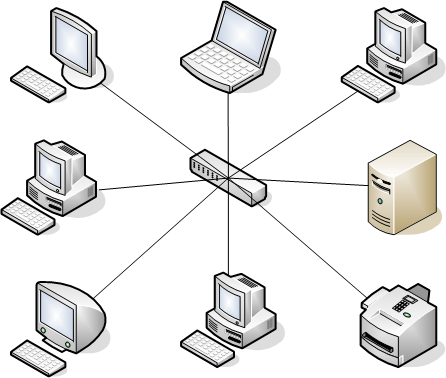
Several articles discussed topologies, such as the star topology and the token ring, but this one was particularly helpful in clarifying these concepts for me.  I found the pros and cons of the different arrangements interesting, for example, the central hub of the star topology allows for certain efficiencies of centralization, but the one-way traffic of the token ring prevents collisions on the same segment.  I think the topologies probably can be leveraged into productive metaphors, but I don’t yet know what these might be.

Emerging concepts: What I’m noticing so far

First, I have noticed two opposing principles, somewhat ironic in their opposition, the principle of materiality and the principle of invisibility.  First, networks—computer, water, electric, social—all have actual physical nodes even as the conduits may be less obviously physical (wi-fi).  Second, the material aspects are largely invisible.  The cables are in the walls, underground, out of sight.  Reductions in size also allows network connections to weave themselves more firmly into the fabric of our lives while becoming less and less visible.  I was reminded of a book that I bought quite a while ago, Beneath the Metropolis, describing underground conduits, ancient and modern, that run under world cities such as New York, Mexico City, Paris, Cairo, Tokyo and others (Marshall & Emblidge, 2006).  The book describes subway tunnels, aqueducts, underground shopping centers, escape tunnels, sewers, even tectonic plates.  Although the book doesn’t particularly go into fiber-optic cables and things like that, clearly these are also similarly invisible and equally important.
I had a personal experience that illustrated the principle of materiality, at least in relation to submarine communication cables.  I was visiting Vietnam for 10 days over Christmas in 2006, and I ran out of money. Frustratingly, my credit card stopped working. The reason, I was told, is that there had been an earthquake in Taiwan.  The irony is that I lived and worked in Taiwan, but the earthquake affected me more than it did my friends back in Taiwan because it had snapped the submarine cable that Vietnam depended on for the internet and rendered my credit card unusable. In the end, I had to call my boss in Taiwan and have him wire money to a bank in Vietnam, and I had to take a motorcycle taxi to another city to pick it up.  I’m not sure exactly how wiring money got around the issues with the cables, but at any rate, my plan B worked, and I was able to finance the rest of my trip.

Networks represented? Art connections

For some reason, this initial discussion of computer networking also got me thinking of art, I’m not sure why.  I thought of Kandinsky because the style of his art reminded me of networks.  

Wikimedia commons image: Vassily Kandinsky, 1923 - Composition 8, huile sur toile, 140 cm x 201 cm, Musée Guggenheim, New York.jpg

Searching out Kandinksy I found a fascinating article from MOMA with a network showing the genealogical relationship between Kandinsky and many of the other abstract artists who influenced him or that he influenced.  I also went searching for and found a contemporary artist doing what is described as new media art.  Deborah Aschheim does mixed media networks using digital devices and sculpture, all in an attempt to represent memory as a neural networks.   

References

Franklin, C. (2000, July 31). How routers work. HowStuffWorks.com. Retrieved from 
http://computer.howstuffworks.com/router.htm
HowStuffWorks.com. (2011, July 19). What is a network server?
HowStuffWorks.com. Retrieved from http://computer.howstuffworks.com/what-is-network-server.htm
Marshall, A., & Emblidge, D. (2006). Beneath the metropolis: The secret lives of cities. New York: Caroll & Graf.
Pidgeon, N. (2000, April 1). How Ethernet works. HowStuffWorks.com. Retrieved from 
http://computer.howstuffworks.com/ethernet.htm
Roos, D. (2008, March 11). How hybrid networks work. HowStuffWorks.com. Retrieved from 
http://computer.howstuffworks.com/hybrid-networks.htm
Roos, D. (2007, June 20). How wireless mesh networks work. HowStuffWorks.com. Retrieved from 
http://computer.howstuffworks.com/how-wireless-mesh-networks-work.htm

Wilson, T.V., & Fuller, J. (2001, April 30). How home networking works. HowStuffWorks.com. Retrieved from 
http://computer.howstuffworks.com/home-network.htm

How Stuff Works: Computer Networking Basics

Computer networks: basic terms

I chose the concept of “networking,” since it appeared to be the only one of my three selections that was on no one else’s list.  “How Stuff Works” took the concept of networking first as a computer term—not surprisingly—but also generated links to social networking, which is just a small leap to another category of digital networking, namely, social media.  Adding a descriptor or two generates other types of networking, in some cases metaphorical extensions of the computer network and in others separate emergences such as telephone or TV networks.  However, because of the primacy of the concept as associated with computer devices connected by cables, I took my explorations in that direction.  The most useful article I consulted, Nick Pidgeon’s (2000) “How Ethernet Works,” was neither the newest nor the first that I consulted, but I found it uniformly useful for establishing key concepts and terminology.    Although networks can be classified as Local Area Networks (LAN) (generally used by a single organization and often within a single building or office) or Wide Area Networks (WAN) (interconnected networks or the internet itself), the same components make up each type.  Lines connecting entities in a network are known as medium, typically a cable, whether coaxial copper cable or fiber optic cable, and a single section of cable connecting two devices is called a segment.  The devices attached to segments, such as a desktop work station or a printer, are called nodesFrames are chunks of information that are communicated between nodes.  Protocols are rules used for constructing frames and for governing connections.  Networks also contained dedicated devices used for controlling the flow of information or passing on information.  These include things like repeaters and bridges, particularly in Ethernet networks.  I also suspect that these are more relevant to earlier networks that were entirely wired (pure Ethernet networks, in other words).  After all, the technology has changed since the time this article was written.  In any case, the more important component for the smooth functioning of networks is the router.  There are smaller, limited versions of these as well as larger powerful versions for large networks and relay points, but in any case, routers are what controls the passage of information, the “crucial device that lets messages flow between networks” (Franklin, 2000).  Routers keep information moving towards its destination but also prevent it from clogging channels or going where it isn’t needed.  In other words, a router is not only a mail carrier but a traffic cop, so to speak.  Information travels through computer networks in packets.  In contrast with a land line telephone call which makes a stable circuit to phone being called, this means that messages are chopped up into manageable sizes and sent in pieces via any efficient route.  It is the routers that send along the packets through maximally efficient routes (Franklin, 2000).  On reach the destination device, packets are reunited to reconstruct the original message.

Network layout and network types

An aspect of networks that emerged as a key element in general was the set-up or the structure of the network.  However, it became apparent to me that from the time that the earlier articles were written that some concerns had diminished.  For example, Pidgeon’s 2000 article on Ethernet discussed radial, or branching set-ups where devices connected in a hierarchical way, back to central hubs, or a token ring set-up where devices are arrayed in a non-hierarchical, circular arrangement and signals are sent one-way around the circle until a destination is reached.  Another term used for a radial type arrangement with a central hub is star topology, mentioned in a 2008 article on hybrid networks (Roos, 2008).  

Establishing a set-up to avoid overworking the same segments with multi-direction traffic was an issue that led to strategic arrangements like the star topology or the token ring.  However, mesh networks take what was a weakness in the past—too many things connecting to too many other things—and have built it into a strength of densely-populated hybrid networks.  Traditional hybrid networks (Roos, 2008)) are networks where some components are connected by Ethernet cables while others are connected wirelessly.  A challenge of hybrid networks is to get a wi-fi signal of adequate strength and to avoid security risks.  Users of home networks are also warned that wireless is slower (Wilson, 2001). Mesh networks, on the other hand, are flexible, densely-populated networks built on relatively few wired connections and a plethora of wireless devices.  

Because of the availability of a large number of devices that can receive and transmit wireless signals, these networks are actually faster and more efficient, say their proponents (Roos, 2007).  Unlike the earlier wired networks, the mesh networks are not limited to single routes on cables but can pass packets in multiple routes using multiple proximate devices.  Due to the use of small wireless radio transmitters that can be stashed in various locations and don’t require burying cables or digging into walls, many large and densely-populated locations are moving towards mesh networks.  Some examples are hospitals, hotels, college campuses, warehouses and even municipal spaces.  In fact, Roos (2007) seems to see mesh networks as a positive development for an increasingly wired future, not only making urban areas better connected and safer since wireless signals will resist challenges to other infrastructure breakdowns, but also as powerful solutions for less developed countries and remote areas.  One cannot help suspecting, however, a flip side in terms of ever greater concerns for privacy.

Emergent concepts

Several things struck me as I read about how computer networks work in a fundamental sense.  First, while computer networks—particularly with the increase of wi-fi options—enable a sense of ubiquitous connectivity in most of the spaces we inhabit, there is, in fact, a level of materiality that is inescapable.  Devices that receive and transmit signals are things we can hold in our hands and some things are always going to be wired.  Related to this is the idea that layout matters.  Where things are positioned in relation to each other matters. Another concept is the idea of flow of communication, of messages, of information, passing back and forth. With that being the case, efficiency is crucial and security is also a relevant issue.  All of these variables require an element of decision-making by real human beings who construct and maintain networks.  While there is certainly an evolution and apparent randomness, there is also agency.
In New Media: The Key Concepts, sociologists Nicholas Gane and David Beer (2012) discuss six core concepts related to new media. The first concept that they choose is “network,” and they begin their discussion with computer engineering, arguing that although the term has become a trope in cultural and social sciences, it is meaningfully traced back to the computer science. Their discussion begins, therefore, with a few—though not all—of the basic terms that I selected for my very simple discussion above.  As metaphor and as theory, we can take these terms as concepts and run with them in different directions, but I believe that it will be helpful at least to consider their material starting point as rooted in computer science.

Activity

Use Google form to engage in a post-reading activity: Questions here.

References

Franklin, C. (2000, July 31). How routers work. HowStuffWorks.com. Retrieved from 
http://computer.howstuffworks.com/router.htm
Gane, N., & Beer, D. (2012). New media: The key concepts. London: Berg.
Pidgeon, N. (2000, April 1). How Ethernet works. HowStuffWorks.com. Retrieved from 
http://computer.howstuffworks.com/ethernet.htm
Roos, D. (2008, March 11). How hybrid networks work. HowStuffWorks.com. Retrieved from 
http://computer.howstuffworks.com/hybrid-networks.htm
Roos, D. (2007, June 20). How wireless mesh networks work. HowStuffWorks.com. Retrieved from 
http://computer.howstuffworks.com/how-wireless-mesh-networks-work.htm
Wilson, T.V. (2001, April 30). How home networking works. HowStuffWorks.com. Retrieved from 
http://computer.howstuffworks.com/home-network.htm